
The shape of the problem
A drop is easy to work with. Something happened on a date, you look at what changed, and you have a direction.
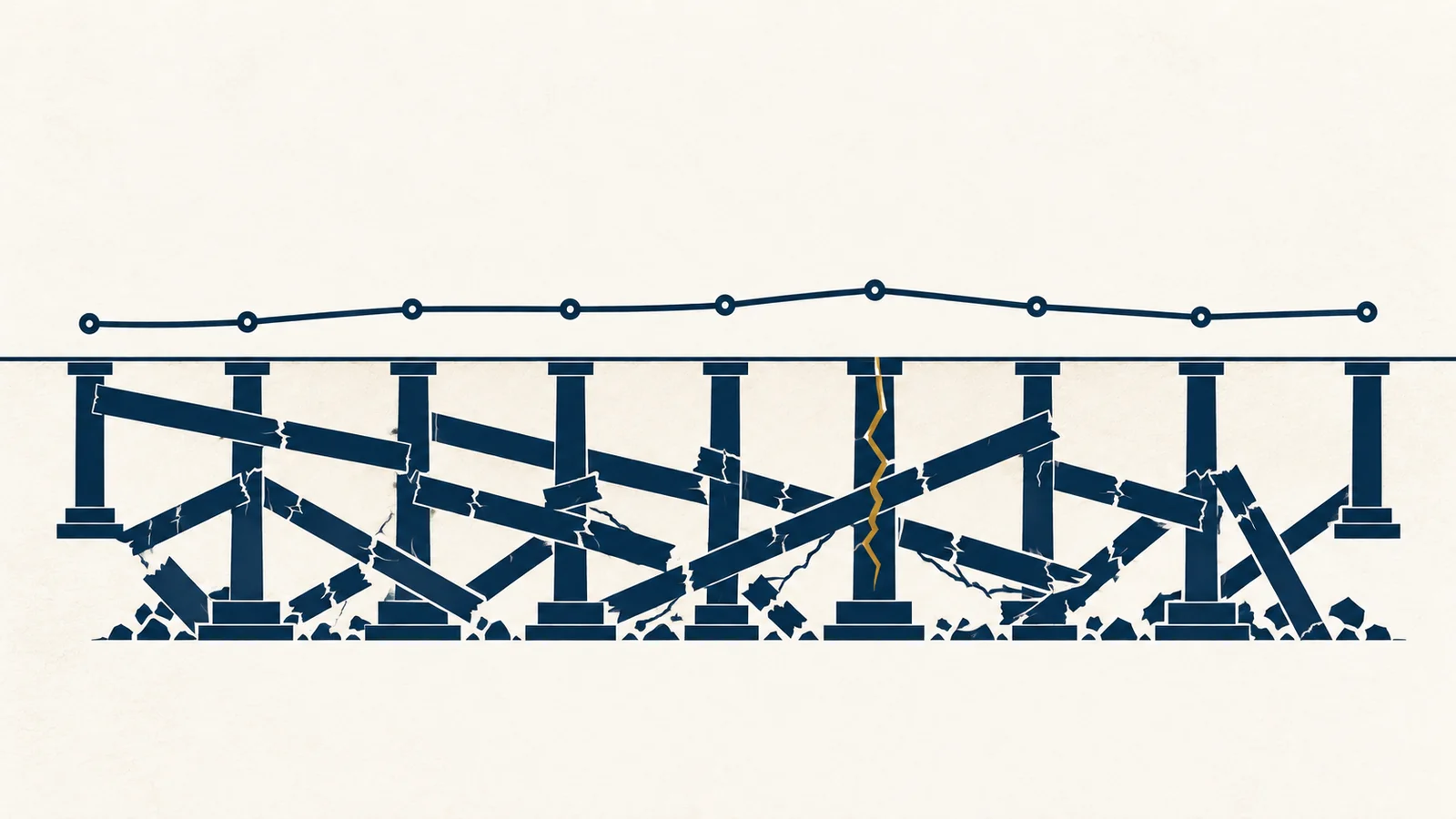
Structural Debt produces the opposite: nothing happens, for a long time. Traffic does not fall. It just does not rise, while the site publishes, improves, builds links and does everything the advice says to do. Two years later the graph is a flat line with more content under it.
That pattern is not bad luck and it is usually not competition. It is a site carrying a load it has never counted.
What counts as debt
Every structural decision a site makes is either resolved or deferred. The deferred ones do not disappear. They stay, and they charge interest.
The common ones:
Redirect chains from old migrations. A URL moved, then moved again, and the first redirect was never repointed. Each hop leaks a little. A chain three deep, multiplied across a few hundred URLs, is a permanent tax on everything that points at the old addresses.
Pages that were never pruned. Content that made sense once, has no traffic now, no links, and no place in the architecture. It is not neutral. It dilutes the topical picture of the site and spends crawl budget that has better uses.
Two pages competing for the same thing. Written at different times by different people, or by the same person who forgot. Neither ranks properly, because the site itself cannot say which one is the answer.
Orphans. Pages with no internal link pointing at them. They are in the sitemap, they are indexed, and nothing on the site says they matter.
The toxicity nobody looked at. Links acquired years ago, or inherited with a domain, that were never assessed.
Pages published without a place. The most common of all, and the least visible: content produced because it was the content calendar’s turn, not because the architecture had a slot for it.
Why it behaves like debt
Because it is taken on for the same reason, and it comes due the same way.
It is borrowed to go faster today. Nobody accumulates Structural Debt out of ignorance. It is taken on deliberately, in small amounts, by people who have a deadline and a reasonable judgement that this particular thing can wait.
It charges interest continuously. Every piece of work done on top of a damaged structure underperforms slightly. You do not see the interest as a line item. You see it as work that should have produced more than it did.
It compounds. Debt raises the cost of the next decision, which makes deferring that one more attractive, which adds more debt.
And it comes due all at once, usually triggered by something unrelated. A redesign. A migration. A theme change. Something routine that forces the structure to be touched, and the accumulated damage surfaces in a single week. This is why so many redesigns are followed by a traffic collapse that nobody can explain: the redesign did not cause the loss, it called in the loan.
Why it stays invisible
Three reasons, and all three are about how the damage is distributed.
It is spread thin. No single redirect chain is worth investigating. The problem only exists in aggregate, and nothing in a standard report aggregates it.
It has no date. Analytics tools are built to explain changes. Structural Debt is not a change, it is a condition, so nothing flags it.
And the work covers it up. A site publishing steadily produces enough new signal to mask the leak. The flat line is the sum of two forces, growth from the new work and drag from the old damage, and from outside it looks like one flat force doing nothing.
That last one is worth sitting with, because it explains the most demoralising version of the problem: the harder a site works, the longer the debt stays hidden.
How to tell if it is your problem
None of these is proof, but together they point one way.
Effort and results have come apart. More content, better content, more links, same numbers.
Old pages do better than new ones. The pages that rank are the ones published before the structure got complicated.
Nobody can say why a given page exists. If the answer to “what does this page support” is silence, it is probably debt.
Every change turns out to be bigger than expected. A theme swap that should take a day becomes a month. That is interest, being paid in hours instead of traffic.
And the diagnosis nobody wants: a site that is genuinely doing good work and genuinely going nowhere is almost never a content problem.
Where this goes
Naming it is most of the value, because a flat line with a name is something you can act on and a flat line without one is just discouraging.
What to repair first, in what order, and how to tell a repair that will pay for itself from one that will not, is the part that belongs in the protocol rather than on a public page. The order it belongs to is in the pillar: repair before design, design before build.