
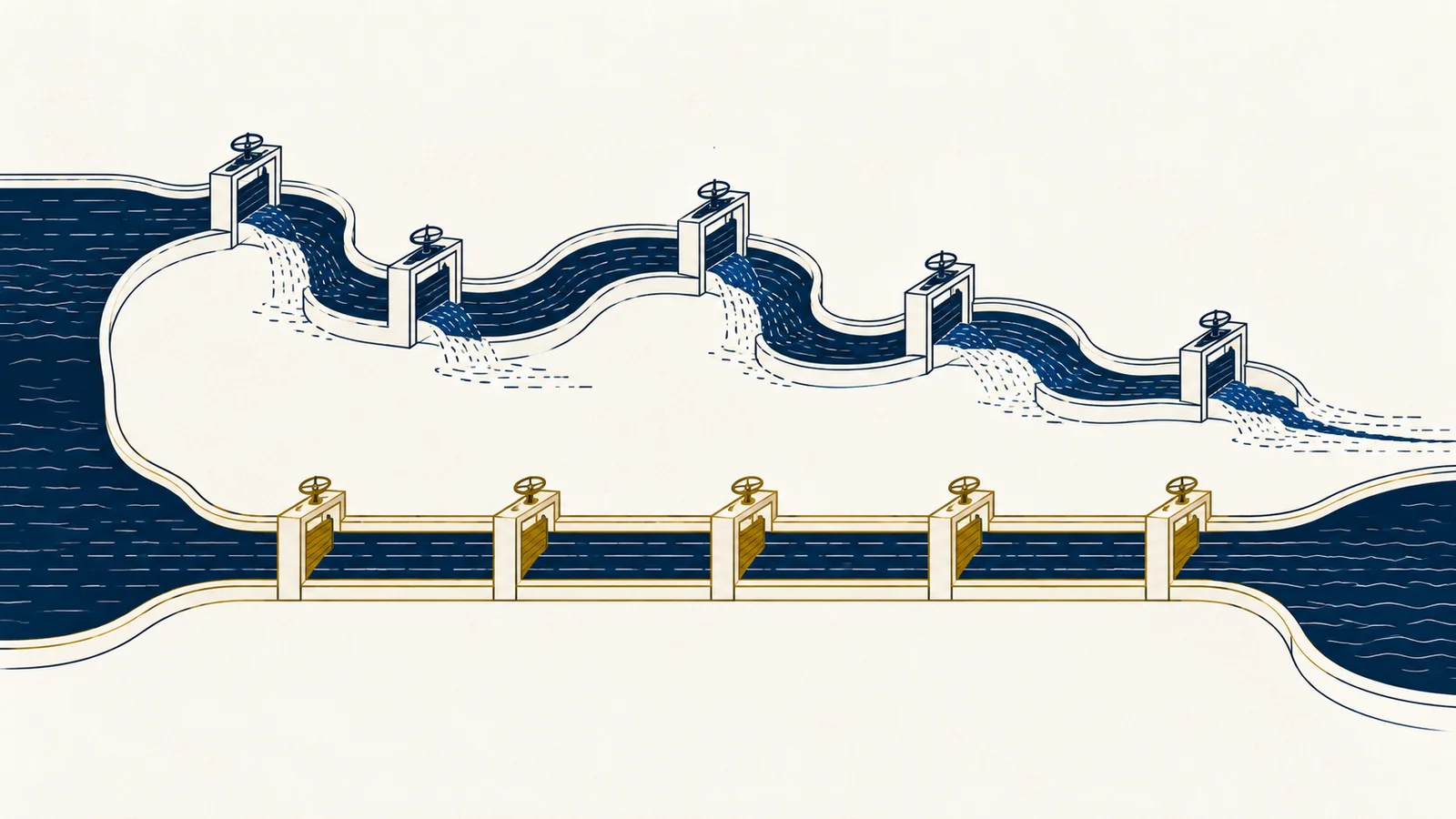
Every link on the web is a transfer of trust. When a page with authority links to another page, it transfers a portion of that authority, its link equity, to the destination. This is the fundamental mechanism that makes the web’s trust system work, and understanding it is essential for managing authority.
Redirects are what happens when that transfer needs to be rerouted. A URL changes, a page moves, a domain is restructured. The redirect tells search engines: the authority that was going to the old URL should now go to the new one. Get this right, and equity is preserved. Get it wrong, and equity is lost, sometimes permanently.
How link equity works
When a page links to another page, it passes a portion of its own authority to the linked page. This is not a fixed amount. It depends on several factors: the authority of the linking page, the number of other links on that page (equity is divided among all outbound links), the relevance of the linking context, and whether the link is dofollow or nofollow.
A dofollow link from a high-authority page with few outbound links passes significant equity. A nofollow link from a low-authority page with hundreds of outbound links passes almost nothing. Most links fall somewhere between these extremes.
Link equity is why backlinks matter. It is why internal linking matters. And it is why redirects matter, because they are the mechanism for preserving equity when URLs change.
Types of redirects
301: Permanent redirect
The 301 redirect is the standard for any permanent URL change. It tells search engines that the old URL has permanently moved to the new one, and that all authority signals should transfer. A properly implemented 301 transfers approximately 85-99% of the original page’s equity to the destination.
Use 301s for: domain changes, URL restructuring, page consolidation, HTTPS migration, and any situation where the old URL will never serve content again.
302: Temporary redirect
A 302 tells search engines the move is temporary. The old URL should retain its authority because it will be coming back. In practice, 302s pass significantly less equity than 301s, and when used incorrectly for permanent changes, they leak authority continuously.
The most common redirect mistake is using 302s where 301s should be. Many server configurations and CMS platforms default to 302. If you have redirects in place, verify their type. Every 302 that should be a 301 is silently losing equity.
307: Temporary redirect (HTTP/1.1)
The 307 is the HTTP/1.1 equivalent of a 302. Same behavior, same authority implications. Preserves the request method (POST stays POST), which matters for forms but rarely for SEO. Treat it the same as a 302 for authority purposes.
308: Permanent redirect (HTTP/1.1)
The 308 is the HTTP/1.1 equivalent of a 301. Same permanent signal, same equity transfer. Less commonly used but functionally identical to a 301 for authority management.
Meta refresh and JavaScript redirects
These are not HTTP redirects. They execute on the client side and are significantly less reliable for equity transfer. Search engines may or may not follow them, and when they do, the equity passed is unpredictable. Never use meta refresh or JavaScript redirects for pages that carry backlinks. Always use server-side 301s.
Redirect chains
A redirect chain occurs when URL A redirects to URL B, which redirects to URL C. Every hop in the chain degrades equity. A three-hop chain can lose 15-25% of the original equity compared to a direct redirect from A to C.
Chains accumulate over time, especially on sites that have been through multiple URL restructures. The first migration redirects old URLs to new ones. The second migration redirects those new URLs to newer ones. The third creates a three-hop chain. Nobody notices because each individual redirect works correctly. But equity is dying quietly at every hop.
Audit for chains regularly. When you find them, collapse them: update the first redirect to point directly to the final destination. One hop. Maximum equity transfer.
When redirects fail
Redirects are not free. They have costs beyond the small equity loss per hop:
- Performance: Each redirect adds latency. A redirect chain of three hops adds measurable load time that affects Core Web Vitals and user experience.
- Crawl budget: Search engines spend crawl budget following redirects instead of indexing content. Sites with thousands of redirects burn through crawl budget faster.
- Maintenance: Every redirect is a rule that must be maintained. Server configurations change, CMS updates overwrite settings, hosting migrations lose .htaccess files. Redirects that are not documented are redirects that will eventually break.
The goal is not to avoid redirects: they are necessary and useful. The goal is to minimize them, keep them to single hops, and maintain them actively.
Strategic redirect decisions
Scenario: URL restructure
You are changing your permalink structure from /year/month/post-name/ to /category/post-name/. Every existing URL must be 301-redirected to its new equivalent. Before doing this, export your backlink profile and identify which old URLs carry external backlinks. These are your priority redirects: they carry the most equity. URLs with no backlinks can be redirected for user experience but carry no authority urgency.
Scenario: Content consolidation
You have five pages about similar topics, each with a few backlinks. Instead of maintaining five thin pages, you consolidate into one comprehensive page and redirect the other four. The comprehensive page receives the combined equity from all five sources. This is one of the most effective authority optimization techniques available.
Scenario: Acquired domain with old URLs
You have purchased a domain and are building new content. The old URLs carry backlinks but the old content is irrelevant. Redirect each old URL to the most thematically related new page. If an old URL about supplements has backlinks, redirect it to your new page most related to health or wellness, not to the homepage, which wastes the topical relevance signal.
When not to redirect
Not every old URL deserves a redirect. URLs with no backlinks and no traffic serve no authority purpose. Redirecting them adds maintenance burden without benefit.
URLs that were spam or adult content should return a 410 (Gone) response, not a redirect. Redirecting spam URLs to your good content associates the spam signal with your pages. A 410 tells search engines the content is permanently removed and no equity should transfer.
Every URL change is an authority decision. Before you change a URL, check its backlinks. Before you delete a page, check its equity. Before you restructure, map every redirect. The cost of getting this wrong is measured in years of lost authority.
| Redirect Type | HTTP Code | Equity Transferred | When to Use |
|---|---|---|---|
| 301 Permanent | 301 | ~90 to 95% | URL permanently moved. Page merged, domain acquired, structure changed. |
| 302 Temporary | 302 | ~0% (equity held, not transferred) | Temporary move only. A/B testing, maintenance. Never for permanent changes. |
| 307 Temporary | 307 | ~0% (same as 302) | HTTP/2 equivalent of 302. Same behavior, same limitations. |
| 308 Permanent | 308 | ~90 to 95% (same as 301) | HTTP/2 equivalent of 301. Preserves request method. Use for API endpoints. |
| 410 Gone | 410 | 0% (intentional removal) | Page permanently deleted with no replacement. Toxic content, irrelevant pages. |
| Meta Refresh | N/A | Partial (unreliable) | Avoid. Client-side redirect. Slow, unreliable equity transfer, poor UX. |
| Redirect Chain | Multiple | Compounds losses (5 to 15% per hop) | Never intentional. Audit and resolve. Always redirect to final destination directly. |
Source: Authority Management System (authoritymanagementsystem.com)
Frequently Asked Questions
How much link equity does a 301 redirect transfer?
A 301 redirect transfers approximately 90 to 95% of the original page’s link equity to the new destination. The small loss is inherent to the redirect mechanism. Despite this, a 301 is far superior to letting equity flow into a 404 dead end, where 100% of the value is lost.
What is a redirect chain and why is it bad?
A redirect chain occurs when URL A redirects to URL B, which redirects to URL C. Each hop loses a small percentage of equity, and chains create fragility: if any link breaks, everything downstream loses authority. Audit for chains regularly and always redirect to the final destination directly.
When should I use a 410 instead of a 301?
Use a 410 (Gone) response when a page should be permanently removed with no replacement, typically for toxic content, irrelevant pages inherited from a previous owner, or duplicate content that should not be redirected anywhere. A 410 tells search engines the removal is intentional and permanent.
Can I redirect an entire domain to another domain?
Yes, through a root-domain 301 redirect. This is common when acquiring expired domains for their backlink profiles. The key consideration is thematic relevance: redirecting a health domain to a finance site transfers minimal real authority because the topical context does not match.