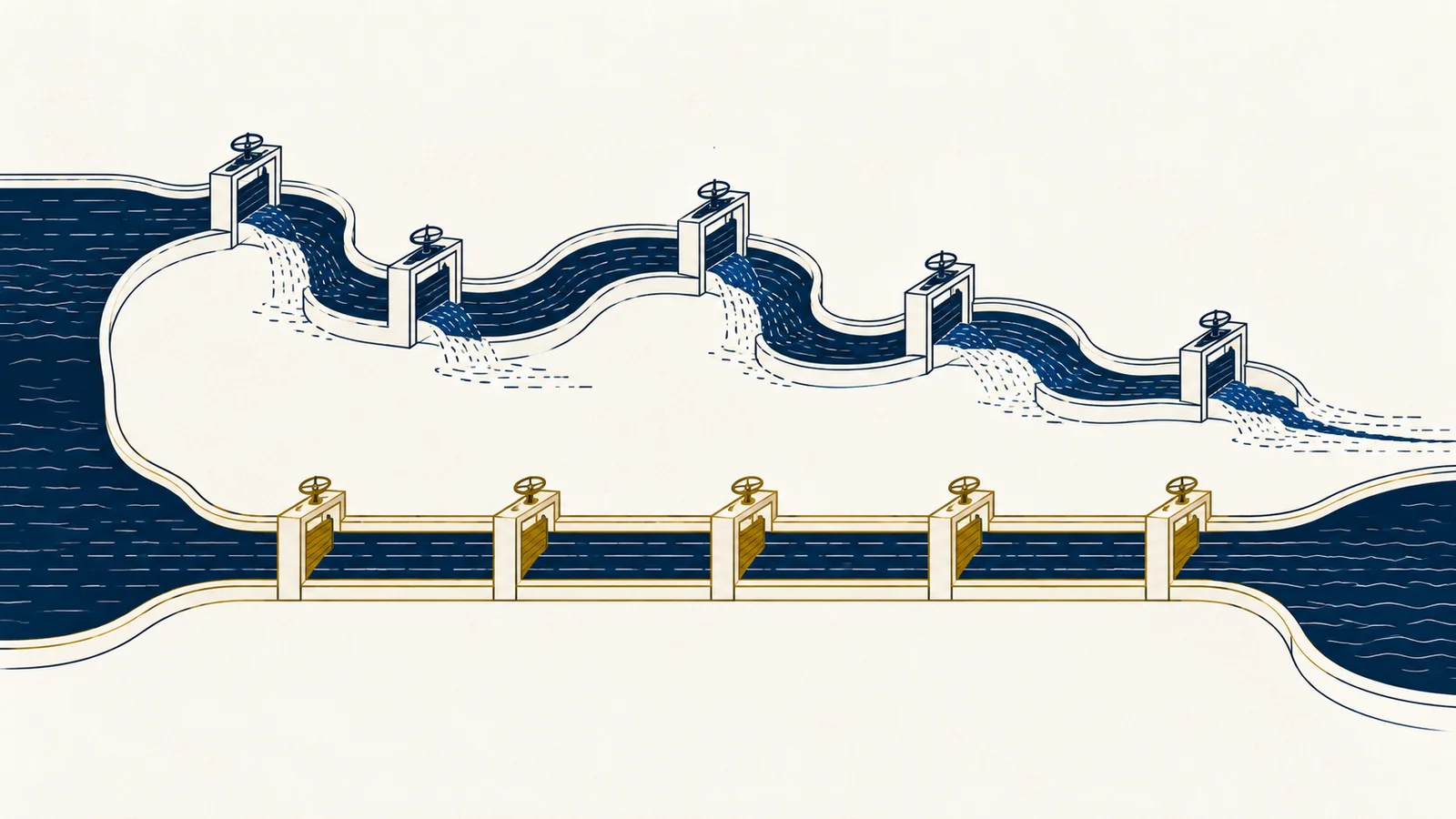

Digital authority is the cumulative trust that search engines, AI systems, and users assign to a web property based on its history, structure, signals, and consistency.
That definition is short. Understanding what it means, and what it does not mean, takes longer. Because most of what people believe about authority is incomplete, and incomplete understanding leads to expensive decisions.
Authority is not a metric
The most common mistake is equating authority with a number. Domain Rating 45. Domain Authority 38. These numbers are proxies: third-party estimates of one dimension of authority, specifically the strength of your backlink profile. They are useful for comparison. They are not authority itself.
A domain with DR 50 built entirely on spam links from link farms has a high number and low real authority. A domain with DR 20 backed by editorial links from established publications has a low number and high real authority. The number tells you the quantity of signal. It does not tell you the quality, relevance, or structural integrity of that signal.
When you make decisions based solely on DR or DA, you are navigating with an incomplete map. The number is one data point. Authority is the full picture.
Authority is not SEO
SEO is a set of activities: optimizing title tags, building backlinks, improving page speed, structuring content for featured snippets, researching keywords. All valid. All tactical.
Authority is the structural outcome that those activities build toward. It is the foundation that makes SEO work. You can execute perfect on-page SEO on a domain with no authority and still rank on page seven. You can publish mediocre content on a domain with strong authority and rank on page one.
This is not a defense of mediocre content. It is an observation about how the system actually works. Authority is the multiplier. Content is the input. Without the multiplier, the input underperforms regardless of its quality.
The distinction matters because most SEO education treats authority as something that happens automatically when you do SEO well. Build links, publish content, wait. That approach works for some sites and fails for most, and nobody explains the structural reasons why.
Authority is not content
Content is necessary. Content alone is not sufficient. This is perhaps the most uncomfortable truth in digital marketing.
There are millions of well-written, well-researched, genuinely useful articles sitting on page four of Google results. They were written by knowledgeable people. They answer user questions accurately. They have proper headings, relevant images, and appropriate length. They do not rank because the domain they sit on has no authority.
A page on a trusted domain is assumed to be more reliable than a page on an unknown domain. This is not a conspiracy. It is a reasonable heuristic for a system that must rank billions of pages. If a domain has accumulated trust through years of consistent signals, its new pages get the benefit of the doubt. New domains do not get that benefit. They must earn it.
Content without authority is invisible. Authority without content has nothing to show. Both are necessary. But authority is the infrastructure that must exist before content can perform.
What authority actually consists of
Authority is the aggregate of multiple signal categories, evaluated continuously by search engines and increasingly by AI systems:
Backlink signals
The links pointing to your domain from other websites. Quality, relevance, diversity, and anchor text distribution all matter. A hundred links from a hundred different relevant domains is worth more than a thousand links from ten spam sites. The age of those links also matters: long-standing editorial links carry more weight than recently acquired ones.
Structural signals
How your site is organized. URL structure, internal linking patterns, canonical declarations, redirect chains, crawl depth, and response codes. A site with clean structure allows search engines to understand and trust the content. A site with broken redirects, orphaned pages, and conflicting canonicals sends mixed signals that erode trust.
Entity signals
Who or what is behind the website. Person schema, Organization schema, consistent NAP (name, address, phone) across the web, presence in knowledge bases, and cross-platform verification. Google’s Knowledge Graph and AI systems both evaluate entity credibility. An identifiable, verifiable entity behind a web property increases trust.
Behavioral signals
How users interact with your site. Click-through rates, time on page, bounce rates, and return visits. These are indirect authority signals: a site that users trust and engage with receives positive behavioral reinforcement in ranking algorithms.
Technical signals
Page speed, mobile responsiveness, HTTPS, Core Web Vitals, and proper implementation of structured data. These are baseline expectations rather than differentiators, but failing them actively hurts authority.
The authority lifecycle
Every web property moves through stages of authority, and understanding where yours sits determines what actions matter most:
New domains start at zero. Everything must be built. Progress is slow. The correct action is to structure the site properly from day one so that authority accumulates efficiently as it grows.
Growing domains are accumulating signals. Content is being published, links are being acquired. The risk at this stage is structural mistakes that compound: wrong URL patterns, redirect errors, linking to low-quality sites. These are cheap to prevent and expensive to fix later.
Established domains have stable authority and consistent rankings. The risk is complacency. Authority decays through neglect: content going stale, links breaking, competitors building stronger signals. Maintenance is not optional.
Inherited domains, domains acquired through purchase or migration, carry structural debt. Every inherited domain comes with toxic backlinks, broken equity flows, and misaligned signals that must be resolved before any new building begins. This is where most value is destroyed, because new owners change things without understanding what they are changing.
Declined domains have lost authority through penalties, neglect, or algorithmic changes. Recovery is harder than the initial build because you must fix existing damage before you can grow again.
Why authority management matters
Authority that is not managed degrades. Links break. Pages return 404 errors. Redirects chain. Content goes stale. Trust signals weaken. The erosion is not dramatic. It does not announce itself. A broken redirect here, an orphaned page there, a toxic backlink accumulating quietly. Each individually insignificant. Collectively, over months and years, devastating.
Managing authority means making deliberate decisions about every structural element of your web property. Before changing a URL, you evaluate the authority impact. Before deleting a page, you check whether it carries link equity. Before migrating a domain, you map every backlink and plan every redirect.
This is not paranoia. It is asset management. Your authority is worth more than your content. Treat it accordingly.