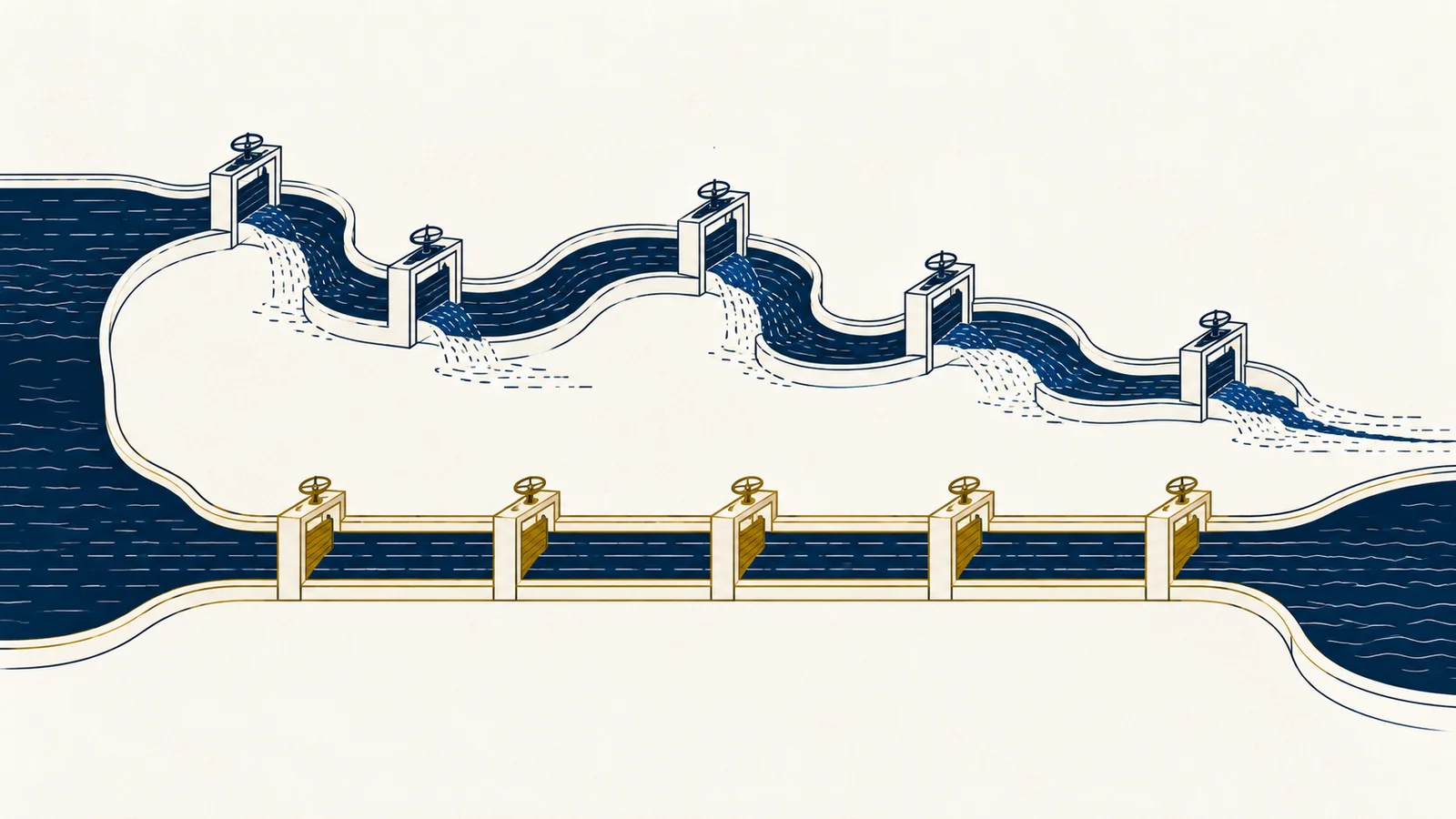
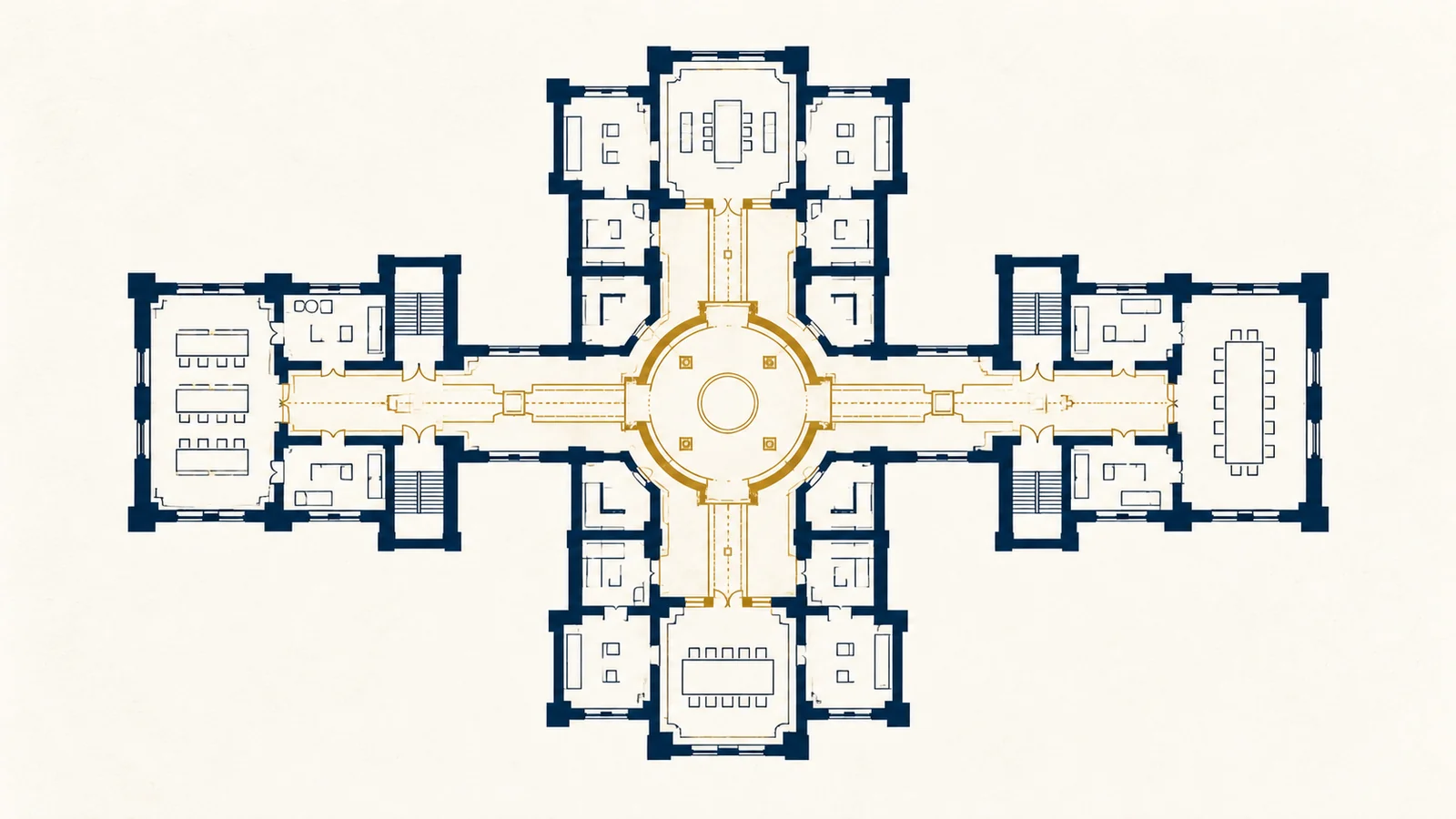
Site structure is not information architecture. It is authority architecture. The way you organize URLs, categories, internal links, and content hierarchies determines how authority flows through your site, whether it concentrates on the pages that matter or dilutes across hundreds of pages that nobody visits.
Most website owners design their structure around content categories. That is logical. It is also incomplete. Structure should be designed around authority flow first, and content organization second. When these two goals conflict, authority flow wins. Because a well-organized site with no authority is invisible.
The silo principle
A content silo is a cluster of thematically related pages that link to each other intensively, creating a concentrated pocket of topical authority. Search engines evaluate topic expertise partly through these clusters. A site with 15 interlinked pages about digital authority signals deeper expertise on that topic than a site with 15 scattered pages about different subjects.
Silos work because they concentrate signals. When an external backlink hits one page in a silo, the internal links distribute that equity to sibling pages. Every page in the cluster benefits from every link that any page receives. This is equity amplification through structure.
Physical silos
Physical silos are reflected in URL paths. All pages about authority auditing live under /authority-auditing/, all pages about link equity live under /link-equity/. The URL structure itself communicates topical grouping to search engines. Physical silos provide the clearest structural signal.
Virtual silos
Virtual silos are created purely through internal linking patterns, regardless of URL structure. Pages can live at any URL but link to each other in a silo pattern. Virtual silos offer more flexibility (you can reorganize linking without changing URLs) but provide weaker structural signals than physical silos.
For most sites, a hybrid approach works best: use physical silos for main topic categories, and virtual silos for cross-topic connections that do not fit neatly into one URL path.
The three-level rule
No page on your site should require more than three clicks from the homepage to reach. This is not an arbitrary guideline. It reflects two mechanical realities of how search engines process your site.
First, crawl budget. Search engines allocate a limited number of pages to crawl per visit. Pages deeper in the hierarchy are crawled less frequently, indexed less reliably, and updated more slowly. A page buried five clicks deep may not be crawled for weeks.
Second, internal link equity. Every click depth reduces the equity flowing from the homepage to that page. The homepage is typically the strongest page on any domain: it receives the most external backlinks and the most direct traffic. Pages one click away get the most equity. Pages three clicks away get significantly less. Pages five clicks away get almost none.
If you have content that matters, it must be reachable within three clicks. If it is not, either the structure needs to be flattened or the content is not important enough to be on the site.
Authority dilution
Every internal link on a page divides its equity among the linked pages. A page with 10 internal links distributes roughly 1/10 of its equity to each destination. A page with 100 internal links distributes 1/100.
This means menus matter. A global navigation menu with 50 links distributes equity thinly across all of them. A focused menu with 8 links concentrates equity on the pages that matter most. Your navigation is not just a usability decision. It is an authority decision.
Footer links, sidebar links, and every widget that adds links to every page on your site affects equity distribution. This does not mean you should remove all navigation. It means you should be deliberate about what you include. Every link on every page is an authority allocation.
URL anatomy
URLs communicate hierarchy to both users and search engines. A well-structured URL tells you where you are, what the content is about, and how it relates to the rest of the site.
Good URL principles for authority: keep them short and descriptive, use hyphens to separate words, include the primary keyword where natural, match the silo structure (e.g., /topic/subtopic/), and never include dates, IDs, or parameters in permanent content URLs.
Changing URLs after publication is expensive because it requires redirects, and every redirect has a small equity cost. Design URLs correctly before publishing. This is a decision that should happen during the structural design phase, not after content is live.
Canonical signals
A canonical tag tells search engines which version of a page is the authoritative one. This matters whenever multiple URLs serve similar or identical content, which happens more often than most site owners realize.
Common scenarios: HTTP vs HTTPS versions, www vs non-www, trailing slash vs no trailing slash, URL parameters creating duplicate pages, paginated content, and print-friendly versions. Without proper canonicalization, search engines must guess which version to trust. Guessing means splitting authority across duplicates instead of concentrating it on one.
Every page should have a self-referencing canonical tag. Every duplicate should point its canonical to the primary version. This is non-negotiable baseline authority hygiene.
Thematic pivoting
Sometimes a domain’s existing authority does not match its intended direction. An acquired domain may have backlinks about technology but you want to use it for marketing content. A domain you have owned for years may have drifted from its original topic.
Thematic pivoting is the process of deliberately transitioning a domain’s topical authority while preserving as much link equity as possible. The key is gradual transition: create a bridge between old topics and new ones, maintain redirects from old URLs that carry backlinks, and build new content silos that reference the old thematic area before fully moving to the new one.
Abrupt pivots (deleting all old content and publishing entirely different topics) destroy authority. Gradual pivots preserve it.
Design structure before content. Not after. The structure determines how authority flows. Content fills the structure. Getting this order wrong means rebuilding under pressure, which is always more expensive than building correctly from the start.
Pre-implementation checklist
Before building or restructuring any site, verify these structural decisions:
- Silo structure defined and documented: every page assigned to a topical cluster
- URL structure finalized: format, depth, naming convention agreed before any publishing
- Internal linking plan: which pages link to which, minimum and maximum links per page
- Navigation structure: global menu items selected based on authority priority, not just usability
- Canonical strategy: self-referencing canonicals, duplicate handling, parameter management
- Redirect plan: if rebuilding, every old URL mapped to its new destination or marked for 410
- Crawl depth verification: no important page more than three clicks from homepage
Frequently Asked Questions
What is a content silo and why does it matter for authority?
A content silo is a group of thematically related pages organized under a shared category, with internal links that keep equity circulating within the group. Silos concentrate topical authority: telling search engines that your site has genuine depth in a specific subject rather than shallow coverage across many topics.
How deep should my site architecture be?
For authority management, the ideal architecture is three levels deep: L1 (category), L2 (subcategory), L3 (content). Every piece of content should be reachable within three clicks from the homepage. Deeper architectures dilute crawl priority and make it harder for search engines to discover and value pages.
How many silos should my site have?
New sites should start with 2 to 3 silos and add more only when existing silos have 10+ articles each and are ranking. Established sites typically perform best with 4 to 6 silos. Beyond that, evaluate whether each silo is genuinely supported with enough content to demonstrate expertise.
Should I change my URL structure to improve authority?
Only if the current structure is fundamentally broken: for example, all content under a flat /blog/ directory with no category hierarchy. URL changes require careful redirect mapping to preserve existing equity. The cost of restructuring is high, so design the URL structure correctly before publishing content whenever possible.