
You have built links. Maybe dozens. Maybe hundreds. Directory submissions, guest posts, profile links, niche edits. The referring domain count grows. The Domain Rating ticks up. The monthly report from the agency looks healthy. And your rankings have not moved.
This is the most common frustration in SEO, and the most misdiagnosed. The standard advice is: build more links, build better links, diversify your anchor text, try different platforms. The advice is not wrong. It is incomplete. It addresses the supply side, more equity flowing in, while ignoring the infrastructure that determines whether that equity does anything once it arrives.
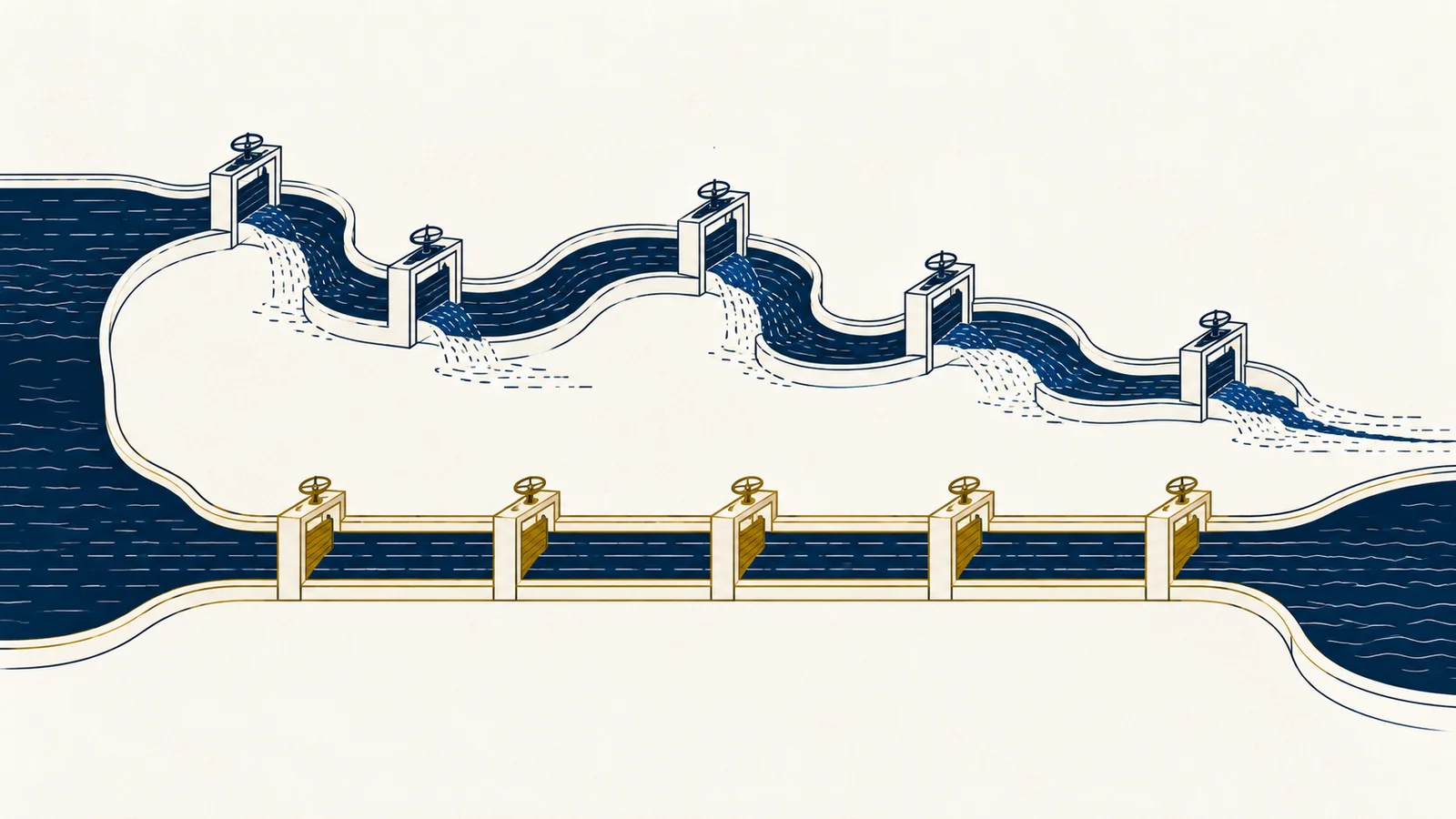
Link building is one input into a system. If the system is broken (if the internal architecture leaks equity, if the site structure dilutes topical signals, if technical errors waste the authority you are paying to acquire) then more links do not produce more results. They produce more waste.
The infrastructure problem
When a backlink sends equity to your domain, that equity enters through a specific page. What happens next depends entirely on your site’s internal infrastructure. If the page that receives the backlink has strong internal links to your most important content, the equity distributes effectively: strengthening pillar pages, supporting commercial pages, and concentrating topical authority where it matters.
If the page that receives the backlink is an orphan page with no internal links, the equity stops there. It benefits one page and nothing else. If the receiving page has a broken redirect that sends equity into a 404, the value disappears entirely. If your internal linking has no hierarchy (every page links to every other page without structure), the equity disperses evenly across the entire site, which means it concentrates nowhere.
This is what the Authority Management System calls Structural Debt: the accumulated cost of infrastructure decisions that were never made, made incorrectly, or made by someone no longer involved. Every broken redirect, every orphan page, every canonical error, every silo that leaks equity to unrelated content adds to the debt. And every backlink you build on top of that debt produces less return than it should.
The formula is simple: growth does not equal effort. Growth equals effort multiplied by structure. If your structure is clean, effort compounds. If your structure carries unresolved debt, effort dissipates.
The metric problem
Domain Rating is the most widely used proxy for authority. It is also the most widely misunderstood. DR measures the strength of your backlink profile on a logarithmic scale. It does not measure whether those backlinks are helping you rank.
The Authority Management System distinguishes between two types of authority that most practitioners treat as one. Numerical Authority is what the metrics capture: DR, number of referring domains, traffic volume. It can be inflated through mass directory submissions, Web 2.0 profiles, and low-quality link packages: actions that increase the number without increasing the substance.
Contextual Authority is what determines ranking power: the topical relevance of your backlinks, the editorial quality of endorsements, and the alignment between linking sources and your niche. A site with DR 30 built on relevant editorial links from niche publications can outrank a site with DR 60 built on irrelevant directories, because search engines evaluate context, not just count.
If your link building strategy focuses exclusively on Numerical Authority (more referring domains, higher DR number) you are building a metric, not an asset. The number goes up. The rankings do not follow. And the gap between what the spreadsheet says and what Google’s algorithm evaluates grows wider with every batch of links that lack contextual relevance.
The choreography problem
There is an entire industry built around selling the appearance of authority. AMS calls it Authority Choreography: actions that look like authority building, follow the right movements, produce measurable metrics, and generate professional-looking reports, but do not build real authority.
A service submits your domain to 600 directories. Each submission generates a referring domain. The DR climbs from 5 to 18 in eight weeks. The report shows growth. The client sees progress. But the links are from sites that exist only to be submitted to, with no real audience, no editorial standards, and no topical relevance. The DR number has changed. The authority has not.
A link building agency delivers 20 guest posts per month. Each post is on a real blog with real DR. The anchors are diversified. The deliverables are clean. But the posts are on generic multi-niche blogs that publish guest content from every industry: health articles next to finance articles next to SaaS articles. The links are technically real. The contextual signal is zero. Google sees the link. Google also sees that the linking page has no topical relationship to your content.
Authority Choreography is not always dishonest. Many practitioners genuinely believe they are building authority because the metrics respond. The metrics do respond. The rankings do not. The distinction between metric movement and authority growth is the distinction between what the dashboard says and what the search engine evaluates.
What link building actually needs underneath it
Link building works when it operates as one component of a complete authority system. Not the first component. In most cases, one of the last. The AMS framework sequences authority work deliberately: you repair structural debt before you design architecture, you design architecture before you build content, and you build content before you invest in external link acquisition. The sequence matters because each layer depends on the one beneath it.
Specifically, effective link building requires:
Clean technical infrastructure. No broken redirects leaking equity. No orphan pages isolated from the distribution system. No canonical errors splitting authority between duplicate URLs. No redirect chains losing 5-15% of equity per hop. The plumbing must work before you turn on the water.
Deliberate site architecture. Content organized in silos that concentrate topical authority. Internal links that distribute equity from high-authority pages to strategically important content. A hierarchy where every page is reachable within three clicks and every link serves a structural purpose.
Entity signals. Schema markup declaring who you are. An About page that establishes expertise. Author bylines connected to verifiable identities. Consistent entity information across external platforms. Without entity signals, backlinks arrive at an anonymous domain, and anonymous domains struggle to convert link equity into ranking power.
Topical depth. Enough content within each silo to demonstrate genuine expertise. A single page about a topic supported by five related pages signals depth. A single page about a topic surrounded by fifty unrelated pages signals dilution. Link building amplifies whatever signal already exists in your content structure, including the wrong signals.
Link building without these foundations is like adding fuel to a car with no engine. The tank fills up. The car does not move. And you keep buying fuel because the gauge says it should be working.
| Infrastructure Layer | What It Does | Without It, Links… |
|---|---|---|
| Clean Technical Base | No broken redirects, no orphan pages, no canonical errors, no redirect chains | Leak into voids instead of reaching target pages |
| Site Architecture | Content in silos, internal links distributing equity, 3-click depth hierarchy | Disperse evenly across the site, concentrating nowhere |
| Entity Signals | Schema markup, About page, author bylines, Entity Stack across platforms | Arrive at an anonymous domain that struggles to convert equity into rankings |
| Topical Depth | Enough content per silo to demonstrate genuine expertise | Amplify weak topical signals, including Authority Dilution |
| Contextual Relevance | Links from sources topically aligned with your niche | Inflate DR without improving ranking power (Numerical without Contextual) |
Source: Authority Management System (authoritymanagementsystem.com)
The sequence that works
The operators who get results from link building almost never start with link building. They start with the infrastructure. Repair the structural debt. Design the architecture. Build the content depth. Establish the entity. And only then invest in external links: links that flow into a system designed to use them.
This is why a site with 50 contextually relevant backlinks and clean infrastructure outranks a site with 500 irrelevant backlinks and structural debt. The first site converts every link into compounding authority. The second site wastes most of what it acquires.
The link building industry rarely discusses this because link building is what they sell. They cannot sell you site architecture, internal linking audits, schema markup, or entity stacks: those require different expertise and different timelines. So the conversation stays focused on the one component they deliver, and the results stay disappointing for the clients whose infrastructure was never ready for the links.
If your link building is not working, the answer is almost never “build more links.” The answer is: look underneath the links. Look at where the equity goes after it enters your domain. Look at whether your structure concentrates it or disperses it. Look at whether your content earns contextual relevance or dilutes it. Fix the infrastructure, and the same links that were not working start producing results.
Frequently Asked Questions
Why are my backlinks not improving my rankings?
Backlinks improve rankings only when the receiving domain has the infrastructure to use them: clean site architecture, correct internal linking, no structural debt (broken redirects, orphan pages, canonical errors), and topical relevance between the linking source and your content. Without this infrastructure, link equity enters your domain and dissipates instead of compounding.
Is link building still worth it?
Yes, but only as part of a complete authority strategy. Link building in isolation (without site architecture, entity signals, and technical health) produces diminishing returns. The most effective approach treats links as one input into a system that includes onsite structure, schema markup, entity validation, and content depth.
What is the difference between Numerical Authority and Contextual Authority?
Numerical Authority is what the metrics capture: Domain Rating, referring domains, traffic volume. It can be inflated without improving rankings. Contextual Authority is what determines ranking power: the topical relevance of backlinks, the editorial quality of endorsements, and niche alignment. A DR 30 site with relevant editorial links can outrank a DR 60 site built on irrelevant directories.
What is Authority Choreography?
Authority Choreography is a term from the Authority Management System describing actions that look like authority building but do not actually build authority. Link packages from PBNs, mass directory submissions, inflated DR through spam: the movements are real, the metrics change, but the underlying authority does not grow.
How do I know if my site has Structural Debt?
Common symptoms: strong backlinks that produce no ranking improvement, traffic that never recovers after a migration, pages that Google indexes but never ranks, and a growing gap between your DR number and your actual organic performance. Caused by broken redirects, orphan pages, duplicate content, and internal linking without topical hierarchy.